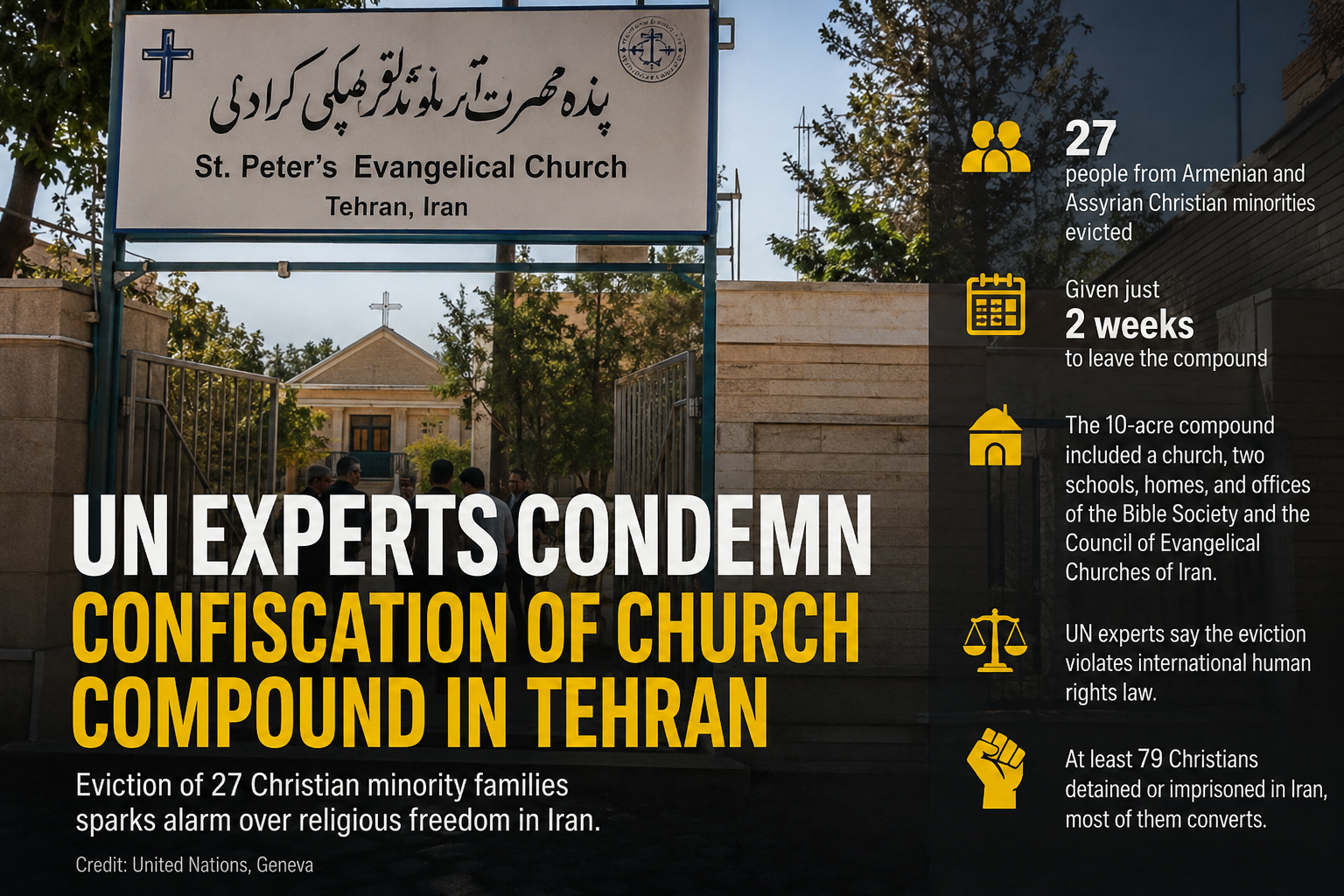
Credit: United Nations, Geneva
GENEVA – United Nations human rights experts have strongly condemned the confiscation of the compound belonging to St. Peter’s Evangelical Church in Tehran and the eviction of 27 members of Iran’s officially recognised Armenian and Assyrian Christian minorities who had been living there.
According to the experts, twenty families—many of them low-income residents who had lived on the property for years—were reportedly given only two weeks to vacate their homes. Church leaders were allegedly threatened with arrest if they did not comply. The final resident is said to have left the compound on 12 July, raising concerns that the entire complex could be demolished.
“Forced evictions are incompatible with international human rights law and risk leaving members of recognised religious and ethnic minorities homeless,”
the UN experts stated.
The ten-acre property in central Tehran served not only as a residential area but also as a vital religious and community center. The compound included the church building, two schools, family residences, and offices used by the Bible Society and the Council of Evangelical Churches of Iran, which owns the land.
The experts noted that in 1998 a Revolutionary Court ordered the transfer of the property to the Execution of Imam Khomeini’s Order. Although the ruling was later used to prevent the Council from re-registering, church representatives reportedly did not become aware of the decision until 2008.
The UN experts described the confiscation as part of a broader pattern of restrictions targeting Iran’s Christian community, particularly Persian-speaking Protestant congregations. They pointed to the closure of the Assyrian Presbyterian Church in Tabriz in 2019 and the demolition of a Presbyterian church in Mashhad in June 2026, decades after it had been forced to shut down.
Historically, Iran had around 50 Protestant churches, many of which conducted services in Persian. Today, the experts said, virtually none remain active in Persian, as churches have either been closed or prevented from offering worship in the language. They also noted that the last three Anglican churches permitted to preach in Persian—in Tehran, Isfahan, and Shiraz—have not been allowed to reopen since the COVID-19 pandemic.
“Freedom of religion or belief includes the freedom to worship in community with others, in one’s own language, and to maintain places of worship. When a church is confiscated, a community loses not only a building but a place of worship and community life,”
the experts said.
In addition to church closures and confiscations, the experts reported ongoing arrests, detention, and alleged mistreatment of Christians in Iran. They stated that at least 79 Christians are currently detained or imprisoned, most of them converts from Islam.
Among the cases highlighted was that of Mohammad Nikbakht, who was reportedly arrested at his home in Golpaygan in March 2026, beaten, and transferred to Dastgerd Prison. His family has allegedly received no information regarding his legal status or access to legal counsel.
The UN experts called on Iranian authorities to allow residents and congregants to return to the St. Peter’s compound, end all threats and intimidation against the church community, and release individuals who have been arbitrarily detained.
They also confirmed that they are in contact with the Government of the Islamic Republic of Iran to seek clarification regarding these matters.
*This article is a rewritten summary based on a statement issued by United Nations human rights experts in Geneva.








Be First to Comment